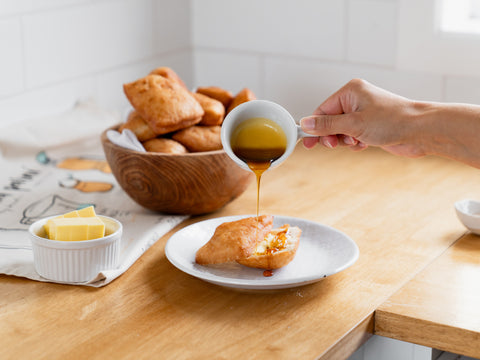
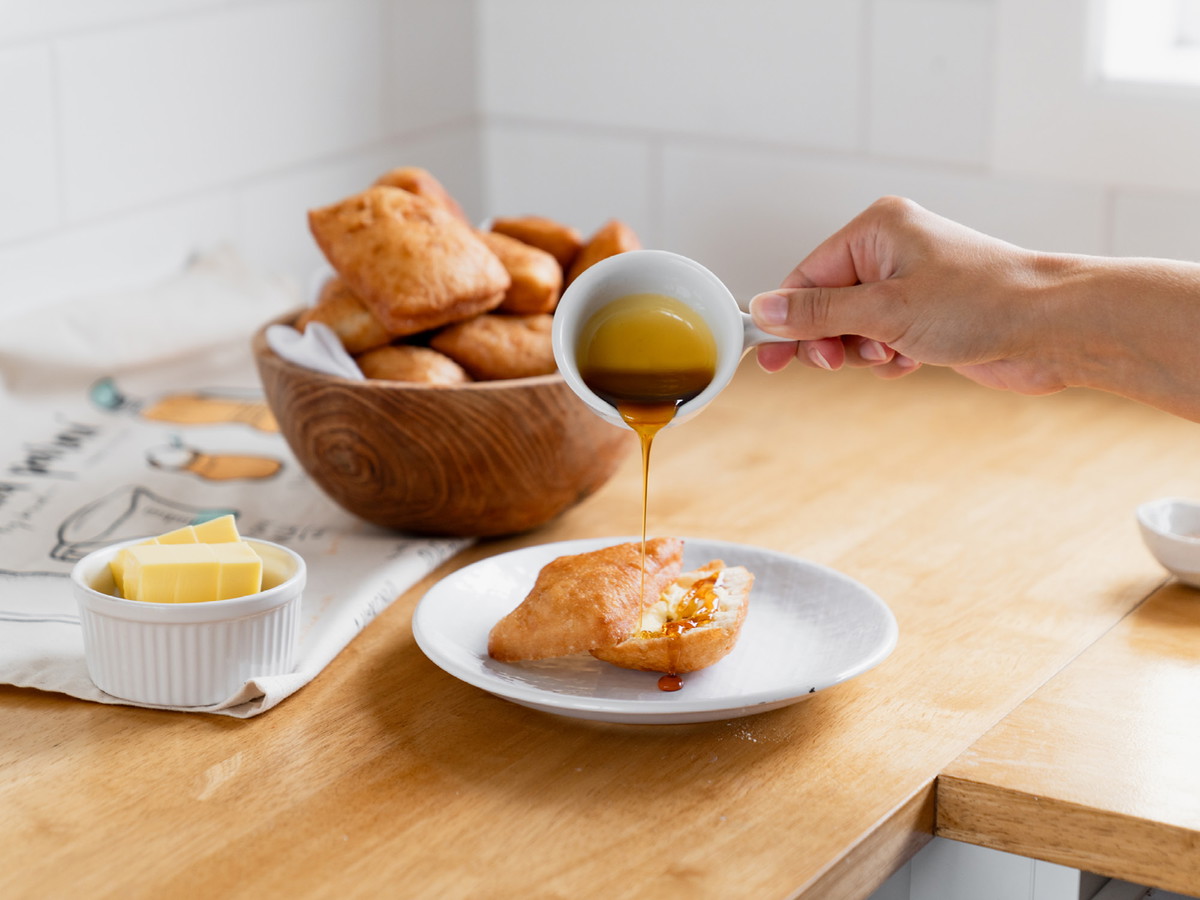
A person's hand pouring golden syrup over a piece of Māori fry bread on a white plate, with a bowl of additional fry bread and a dish of butter cubes in the background, set on a wooden kitchen counter.

Parāoa Parai: Best Fry Bread Recipe

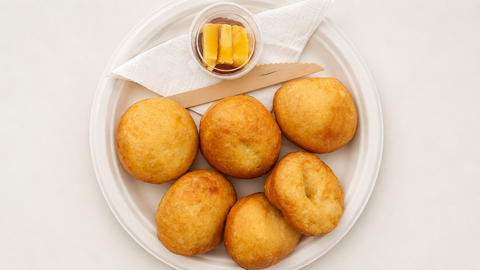
Parāoa Parai (Fry Bread) has come to be a much-loved Māori delicacy that is often served at hākari (feasts) on the marae, festivals, Matariki and Waitangi celebrations, with boil up or hāngī, or paired with some creative variations of sweet or savoury toppings.

A pile of golden-brown Māori fry bread on a wooden cutting board, wrapped in a white cloth, with a glass jar, a bowl, and a vase with dried flowers in the background, on a kitchen counter by a window.

Fried bread is a staple found in various cultures globally. Parāoa parai, New Zealand's own version, connects us to other indigenous communities who have their own adaptations. For instance, Native Americans have their fry bread, which emerged under the pressures of colonisation, South Americans enjoy sopapillas, Punjab's bhatura, South Africa's vetkoek (literally 'fat cake'), Hungary's lángossfenj in northwest Africa, Bannock in Canada (with Scottish origins ), China's breakfast youtiao (油条), and the Dutch oliebol to name a few. The culinary tradition of frying bread spans continents, highlighting the universal love for this comforting food among cultures.

Fry Bread

Although there is constant debate around the name of these crunchy clouds of heaven (Fry Bread vs Fried Bread), we can all agree that they are dangerously delicious. It is important to recognise that while fry bread holds a significant place in contemporary Māori cuisine, it does not originate from the traditional diets of our tūpuna (ancestors). It was first introduced to Māori in the 19th century following the arrival of European settlers. The bread was initially adopted due to the introduction of wheat flour and baking powder to the Māori diet, ingredients that became accessible through European trade. Ruatara, a Ngāpuhi rangatira, was among the first to plant wheat as a crop in New Zealand in 1813 (source: Te Ara & NZFMA). The traditional method of making parāoa parai typically involved baking powder, flour, water, sugar, and salt, and fried in lard or dripping. Using baking powder as the leavening agent gave it a denser, scone-like texture. This method is still widely used, however, using yeast instead of baking powder is becoming popular due to producing a lighter, fluffier texture reminiscent of more conventional bread.

Kitchen scene with a tea towel featuring an illustrated Māori fry bread recipe hung on the wall, a wooden bowl, and a plate of fry bread on a wooden board on the countertop, with a subway tile backsplash in the background.

Our famous fry bread recipe was first shared before the August lockdown 2021 in Aotearoa — and since then thousands of kiwis have tried and tested it and given the big tick of approval! It is an easy-to-follow recipe that will give you perfect results every time. Crispy and golden brown on the outside, and fluffy on the inside. Trust me, you'll want to save this recipe to your favourites, it's a winner! Just be prepared to be the designated fry bread cook in your whānau after you share your first batch. My only rule if you make this recipe is to make extra every time so you can bless a neighbour, kaumātua (elder), or someone who lives alone with a small batch.

Don’t forget to tag us @maimoa.creative when you give this recipe a crack 👩🏽🍳

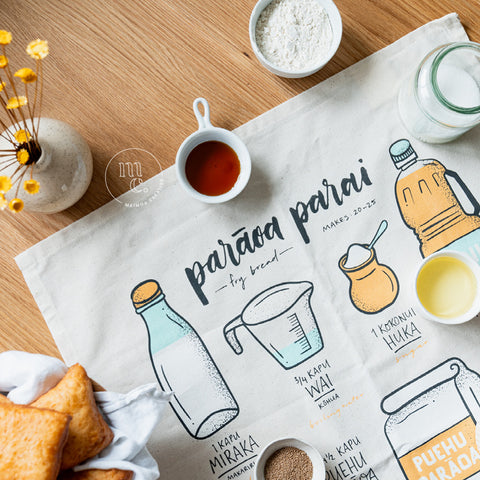
Overhead view of a table with a tea towel illustrated with a fry bread recipe and drawings of ingredients. Around the tea towel are the actual ingredients including oil, flour, yeast, sugar, a jar of milk, butter, and two stacks of fry bread on wooden boards.

Level up your fry bread game with Aotearoa’s Top 10 Fry Bread Toppings, voted by the people.

Illustrated graphic titled “Aotearoa’s Top 10 Fry Bread Toppings 2025” by Maimoa Creative, featuring icons of popular sweet and savoury toppings.

Download our printable Step-by-Step Guide — a simple, visual walkthrough perfect for keeping on the bench while you cook, especially with tamariki or in the classroom.

Flat lay of Parāoa Parai fry bread step-by-step recipe guide print, styled on a rustic white surface with dried flowers and soft natural lighting.

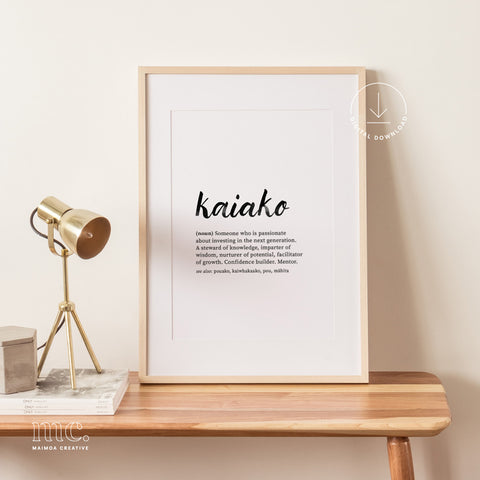
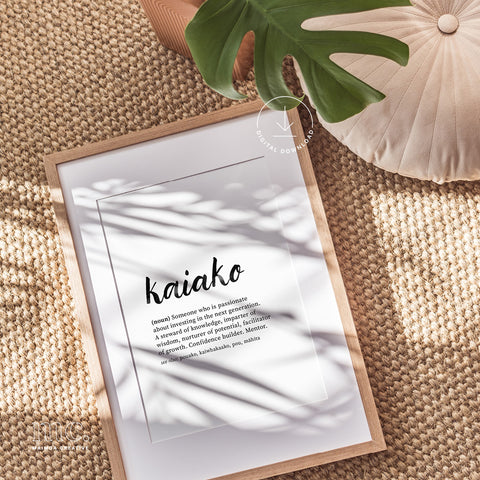
There’s also a digital download of the illustrated recipe design available — perfect for framing and displaying in your kitchen at home.

Parāoa Parai: Crispy & Fluffy Fry Bread

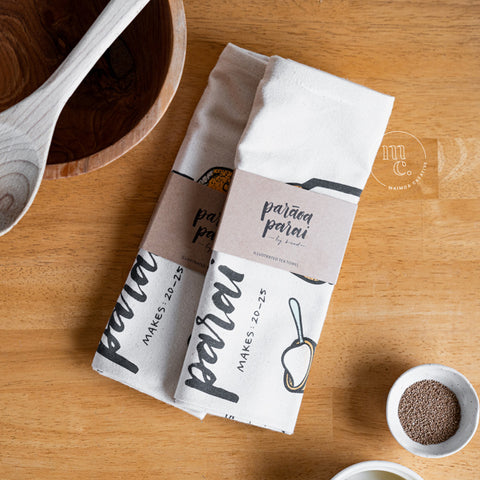
A no-fail recipe that will get you perfect results every time! Crispy and golden brown on the outside, and light and fluffy on the inside. Have our recipe at your fingertips with our specially illustrated recipe tea towel.

Author
Maimoa Creative
Prep Time
75 minutes
Cook Time
30 minutes
Servings
20 fry bread
Category

Bread

Cuisine

Māori

Ingredients

  • 1 cup chilled milk | Kia 1 te kapu miraka mātao
  • ¾ cup boiling water | Kia ¾ o te kapu wai kōhua
  • 1 Tbspn dried active yeast | Kia 1 te kokonui īhi
  • 1 Tbspn sugar | Kia 1 te kokonui huka
  • 4 Tbspn vegetable oil | Kia 4 ngā kokonui hinu
  • 4-4 ½ cups white flour | Kia 4-4 ½ ngā kapu puehu parāoa
  • 1 ½ tsp salt | Kia 1 ½ ngā kokoiti tote
  • Oil for frying | He hinu hei parai
  • Illustrated recipe tea towel | Tītāora tohutao

Directions

  1. Combine the boiling water and chilled milk in a large bowl. Test temperature with finger to make sure it’s not too hot (will kill yeast), or too cold (yeast won’t activate). | Riringihia te wai kōhua me te miraka mātao ki tētahi oko nui. Whakamātauhia te pāmahana ki tō matimati e kore ai e wera rawa (kei mate te īhi), e kore ai rānei e mātao rawa (kāore te īhi e mahi).
  2. Add sugar, oil, and yeast, and stir. Set aside for 10-15 minutes until sponge-like from yeast activating. | Raua atu te huka, te hinu, me te īhi, ka kōrori ai. Waiho mō te 10-15 meneti kia pūngorungoru ai nā te mahi o te īhi.
  3. Add 4 cups of flour and the salt. Fold together gently, being careful not to overmix. Add more flour if it’s still too sticky (usually another ½ cup is required). | Āpitihia atu ngā kapu puehu parāoa e 4 me te tote. Āta whētuia, kei whakaranua rawatia. Āpitihia atu he puehu parāoa anō mēnā kua hāpiapia rawa tonu. (I te nuinga o te wā, me tāpiri anō tētahi haurua o te kapu).
  4. Gently knead together into a ball, then leave in bowl and cover with a tea towel. Leave to proof until doubled in size (approx 1 hour). | Āta pokepokea hei pōro, ka waiho ai ki tētahi oko. Hipokina ki tētahi tītaora, ka waiho ai kia huarua rā anō te tupu. (tōna 1 hāora).
  5. Remove risen dough from the bowl onto a lightly oiled bench (oiling instead of flouring the surface makes for cleaner oil when frying). | Tangohia atu te pokenga kua tupuria mai i te oko ki te paenga kua whakahinuhinutia (Mā te pani ki te hinu, kaua ki te puehu parāoa, ka mā ake te hinu ka parai ana).
  6. Gently pat the dough out to a 2cm thick rectangle and cut into 6cmx6cm squares. Should make approx. 20 pieces. Spread out the pieces on an oiled surface, cover with a tea towel and leave to proof for another 15 minutes. TIP: Roll the edge of a dinner plate along the dough to cut instead of a knife. This will seal the edges and produce a more 'pillow-like' outcome. | Āta takapapangia te pokenga, kia tapawhā ai te hanga, kia 2 henemita hoki te mātotoru, ka wāwāhi ai kia 6 henemita pūrua te nui o ngā tapawhā. Whakamahia rānei te kotikoti pihikete. Ka āhua 20 ngā wāhanga. Horahia ngā wāhanga ki tētahi papa kua whakahinuhinutia, hipokina ki tētahi tītaora, ka waiho ai mō te 15 meneti anō. TĪWHIRI: Hāunga te māripi, hurihia te tapa o tētahi pereti ki te pokenga hei wāwāhi i te pokenga. Mā tēnei e hīritia ai ngā tapa, ā, ka hua mai tētahi āhua pērā me te urunga.
  7. Heat a medium size pot of oil to 165°C. Make the oil deep enough so that the dough won’t be touching the base and can float while cooking. TIP: To check temperature is hot enough, place end of a wooden spoon in the oil. If it bubbles, the oil is ready. Oil is too hot if the dough goes golden brown too fast and the inside is still doughy/uncooked. | Whakamahanatia te hinu ki tētahi kōhua wawaenga noa kia 165° tohurau te pāmahana. Whakaritea kia hōhonu te hinu e kore ai te pokenga e pā ki te papa, ā, ka rewa kē ka tunua ana. TĪWHIRI: Hei whakamātau i te pāmahana, hoatu te kakau o te koko rākau ki te hinu. Ki te pupū, kua rite te hinu. Kua wera rawa te hinu ina tere rawa te kōuraura haere o te pokenga, ā, ka kaiota tonu o roto.
  8. Gently place dough in the hot oil in batches and cook until golden brown, approx. 30 seconds per side. | Āta tukuna ngā wāhi pokenga ki te hinu wera, ka tunu ai i ia taha mō tōna 30 hēkena.
  9. Once cooked, remove from oil and transfer onto a paper towel-lined dish. Allow to rest for 5 minutes before serving. | Ina rite, tangohia atu i te hinu, ka tukuna ai ki tētahi paepae kua ūhia ki te pepa tāora. Waiho mō te 5 meneti, ka toha atu ai.